
Dispatches from a Disappearing World: Beans, Tomatoes, Corn
On the hidden labor, poisoned fields, and lost abundance behind America’s most ordinary foods

These last few weeks I’ve been busy harvesting so many wonderful things from our gardens—all open-pollinated heirloom seeds, some I’ve been saving for years. There is relationship in seeds, and I love to let plants go through their entire life cycle, to witness them through it. Collecting their seed at the end, helping keep their genetics open and diverse. How special it is to share and bear witness to another organism’s life from start to end. I feel privileged every year to have relationships with plants; they help me witness my family and friends as we all move through our life cycles too.
This week I harvested amazing corn, mostly grown to witness and love, some to eat. Holding those ears, I thought again of Florida and pulled out another revision of my field notes. This week in Dispatches From a Disappearing World, I present: green beans, tomatoes, and corn.


Green Beans, Tomatoes, and Corn
When I was the artist in residence at my own local Homestead Branch Library for ProjectArt, I taught three art classes a week—small rooms full of children, families leaning against the doorframes, the hum of a community showing up for itself. As a Homestead resident, it was more than teaching; it widened my lens. I began to see not just the faces of neighbors but the systems that shaped their days, the invisible scaffolding of labor, land, and economy.
Driving through Homestead then, you passed the repetition of new suburban neighborhoods, houses standing in rows where fields once stretched. Between them remained acres and acres of farmland, still in service to monocropped giants. Beans, squash, tomatoes—their cycles dictated not by farmers walking the soil but by chemical prescriptions: fungicides, herbicides, pesticides, fertilizer, all delivered in a haze. Farming without farmers, fields as laboratories.
Green Beans
That year, the green bean caught my attention. South Florida grew more of them than anywhere else in the country—some 33,000 acres. For decades, Homestead and Immokalee had been the center of U.S. winter vegetable production, supplying beans, squash, and tomatoes to the rest of the country when northern fields lay dormant. The statistics were staggering: more than half of the green beans eaten in America during the winter months came from these fields.
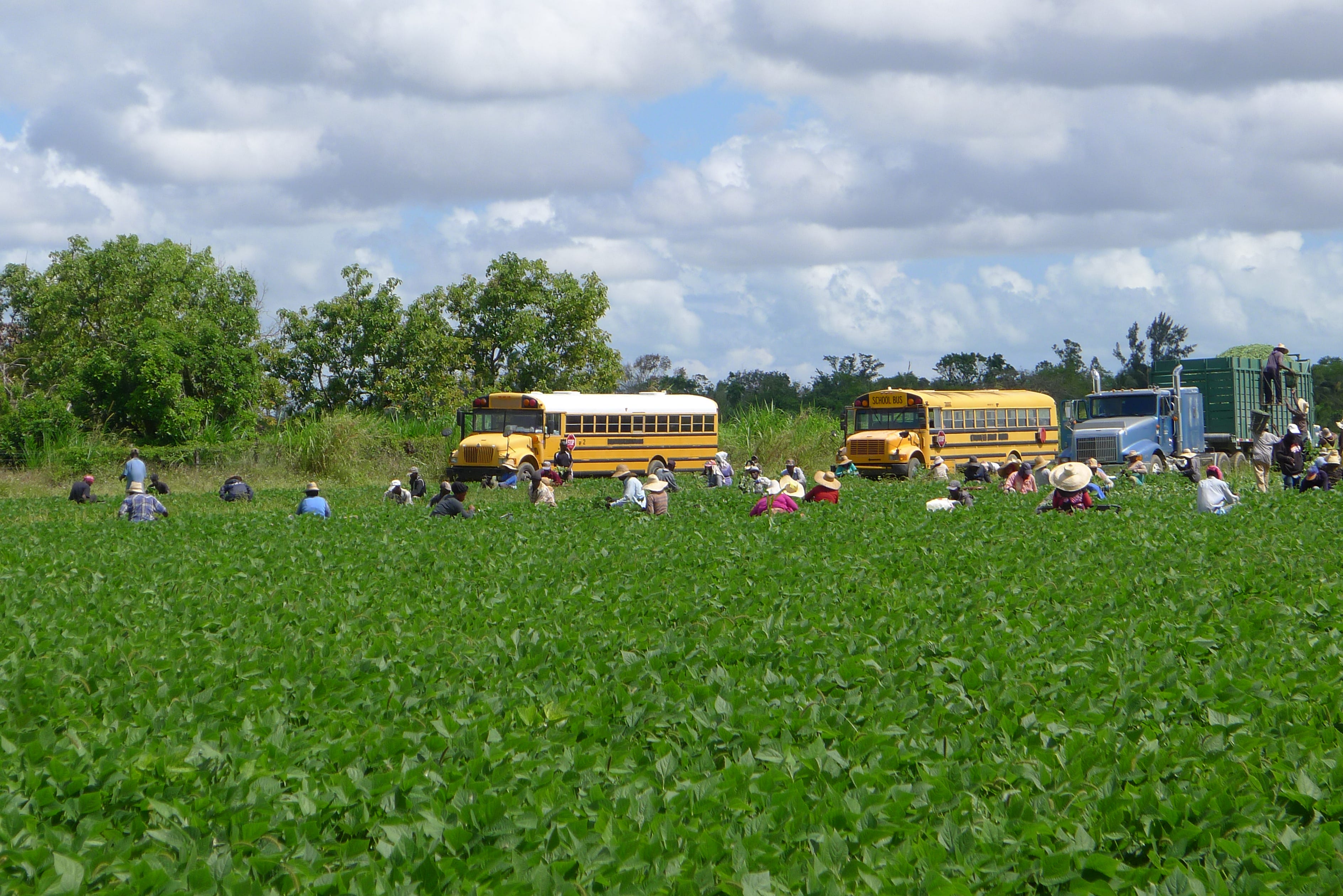
At harvest, school buses painted white and yellow rumbled off the Turnpike into the back roads, carrying workers in straw hats and headscarves. To pass one of these fields was to glimpse a scene suspended between beauty and unease: rows alive with movement, hands filling buckets, bodies bent low to the ground.
The labor of picking beans has long been coded as invisible. In the early 20th century, it was Bahamian and Black migrant workers in South Florida’s fields, later joined by Mexican braceros during WWII, and by the 1980s, large numbers of Haitians, many undocumented, found themselves filling the buses. By the time I walked into the field, it was older Haitian workers who still bent to pick beans—paid by the bucket, pennies per pound. Younger generations, the field manager told me, no longer wanted such grueling work.
I walked into one such field with a recorder and a camera. The sound arrived first—the soft percussion of beans hitting plastic. I greeted workers, received nods, until a foreman waved me away: no pictures, no video. I persisted until the field manager appeared, willing to talk. He told me most of the bean pickers were Haitian, bused in from Little Haiti. He wasn’t sure who actually held the contracts, only that the work was disappearing. He said machines would soon replace human hands, though not without waste; machines broke beans, left many behind, lacked the sensitivity of human touch.
Later I followed the beans to the pack house. Inside was a choreography of motion. Conveyor belts spilled beans into holding areas, hands darted, selecting, boxing, forklifts zigzagged, fans buzzed, gum snapped. At the end of the line came the waste. Cull beans poured like waterfalls into trucks bound for compost, landfill, or animal feed—their abundance rendered invisible by industry’s standard of perfection. A crooked bean, a blemished bean, a bean too long or too curved, all discarded.
And yet all of these beans had been grown the same way: genetically modified seed drilled into soils layered with chemical regimes. Florida’s sandy soils never held nutrients well; without constant applications of fertilizer and pesticides, almost nothing could be grown at scale. So every harvest was propped up on a cocktail of chemicals: atrazine, glyphosate, chlorothalonil. The fields were green but not alive. The soil beneath was thin, its microbial networks stripped, dependent on constant inputs to suppress weeds, to fight pests, to deliver nutrients in liquid form.
The beans themselves, compared to their heirloom ancestors, were fragile in a different way: bred for uniformity, quick growth, durability in shipping, but nutrient-poor. A simulacrum of nourishment. What was once a food rich in protein, fiber, and micronutrients had been streamlined for appearance, efficiency, commodity pricing.
And this was the great irony: beans were once sacred companions in Indigenous agriculture across the Americas. They were one of the “Three Sisters,” grown with corn and squash in interdependent balance—beans climbing cornstalks, fixing nitrogen into the soil, feeding the squash as they shaded the ground. It was a model of reciprocity, of plants feeding each other as they fed people. What I saw in South Florida was the opposite: monoculture stripped of interdependence, the bean divorced from its companions, forced into rows where life was held up by chemicals rather than relationship.
The history carried forward into kitchens, too. Beans, once a pillar of Indigenous nutrition and community resilience, became something else in American food culture: canned goods stacked in pantries, string beans softened to olive green in brine. During WWII they were soldier rations, later “Victory garden” staples, and by the 1950s they were corporate commodities, advertised as the symbol of convenience and abundance. The infamous green bean casserole—Campbell’s mushroom soup, canned fried onions—emerged in 1955 from a test kitchen, promoted as quick and thrifty, until it rooted itself in the mythology of Thanksgiving. Beans, stripped from their original ecology, had been repackaged as tradition.
For my installation at the Museum of Contemporary Art in North Miami, I brought fragments of this journey—stacks of beans hauled in on the back of a truck, and a video from the field, the footage inverted to shield the pickers’ identities. An ethnography of America’s green bean, refracted through art.
Tomatoes
When I first moved to Miami, tomatoes arrived in my awareness through a newspaper article: a brief report on a lawsuit by a Mexican farmworker against Burger King, alleging that workers had been sent into fields too soon after chemical spraying and that the worker’s baby was born paraplegic. I clipped the piece from the Miami Herald and then kept buying papers, expecting follow-ups. Nothing else appeared. The story vanished into the margins.
Watching the seasons of Florida agriculture, I saw tomato fields go up with the Florida Weave—stakes pounded into the ground, string tied to keep the vines upright. Then came the spray rigs, day in and day out: herbicides, pesticides, fungicides, fertilizers. Skulls-and-crossbones signs warned of danger, though the danger never stopped the workers. At harvest, crews of mostly Mexican agricultural laborers bent fast and low, their buckets filling trucks by hand, the work relentless. Florida tomatoes, picked green and gassed with ethylene to redden, were bred for shelf life, not flavor. They had been stripped of sweetness, stripped of resilience.
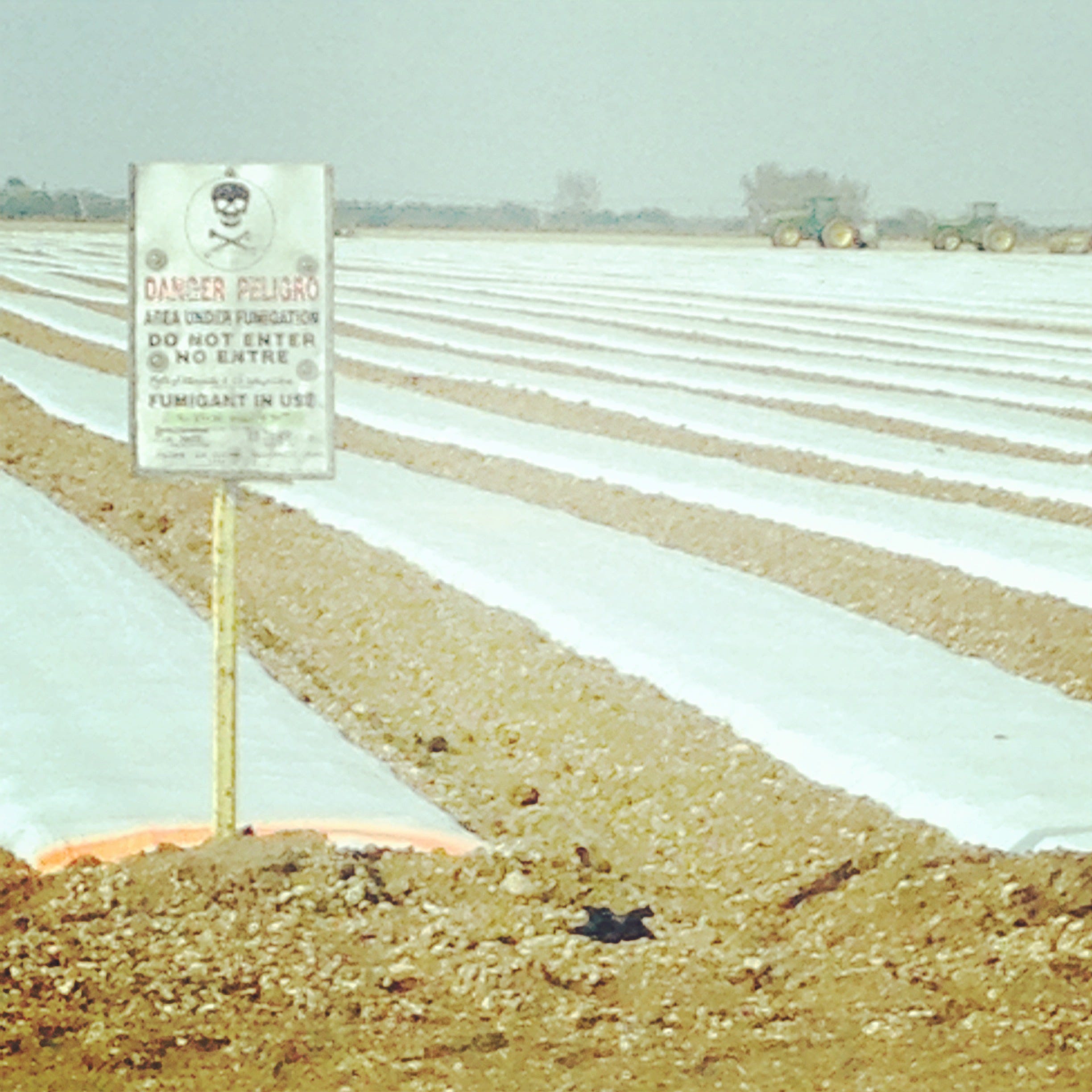
Afterward, the fields were cleared. Plastic mulch and tomato stalks piled up and set aflame, the smoke of burning polymers and GMO residue released into the air. The next day the ground was tilled, planted again with beans or squash. An endless cycle of chemical dependency and extraction. Did no one read Silent Spring? Why could we not heed the warnings etched half a century earlier?
“The most alarming of all man’s assaults upon the environment is the contamination of air, earth, rivers, and sea with dangerous and even lethal materials. This pollution is for the most part irrecoverable; the chain of evil it initiates not only in the world that must support life but in living tissues is for the most part irreversible.” — Rachel Carson, Silent Spring
The irony is that the tomato itself is an ancient teacher. Traced back to Mesoamerica, it was cultivated and cherished by Indigenous peoples long before it became the commodity that fills American sandwiches and supermarket aisles. Pueblo people once believed ingesting the seed could grant visions; the Aztec name tomatl carried echoes of fertility and abundance. For centuries, tomatoes grew in astonishing diversity—striped, purple, tiny as beads, large as fists—each variety carrying a different story of place, taste, survival.
Industrial agriculture narrowed that abundance to a handful of uniform cultivars, chosen not for flavor but for their ability to travel thousands of miles and stack neatly on pallets. By some estimates, more than 90 percent of tomato varieties grown in the United States a century ago have disappeared. The loss is not only botanical but cultural: recipes, tastes, colors, and memories have been erased from the table. What remains are hybrid tomatoes designed to withstand pesticides, bred for yield, disease resistance, and profit margins—yet brittle in every other way.
As a child, I disliked tomatoes. Only later did I realize I had never eaten one in its truth. The first time I bit into a sun-warmed beefsteak heirloom, its juices running down my wrist, I was undone. From then on, I sought the wildest, most eccentric varieties: Green Zebra, Indigo Rose, Peach, Hungarian Heart, Everglades. Each one, a different tongue of light.
To grow tomatoes at home was to enter a ritual of care. Saving seeds year after year meant knowing the life of a plant intimately—its shape, quirks, vulnerabilities. It meant selecting not only for flavor but for resilience, preserving diversity in my own small way. Each seed carried history, possibility, the whisper of adaptation. In tending them, I became part of an ancient lineage of seed keepers, those who refused the narrowing of choices dictated by industry.
Every year of tomato growing, I pinch suckers, fuss over them like family. The plants are hairy; their stalks leave my hands coated in a sticky silver-grey film—fats and sugars seeping through, skin to skin. They respond to attention. They demand presence. They rewarded it with sweetness, complexity, beauty.
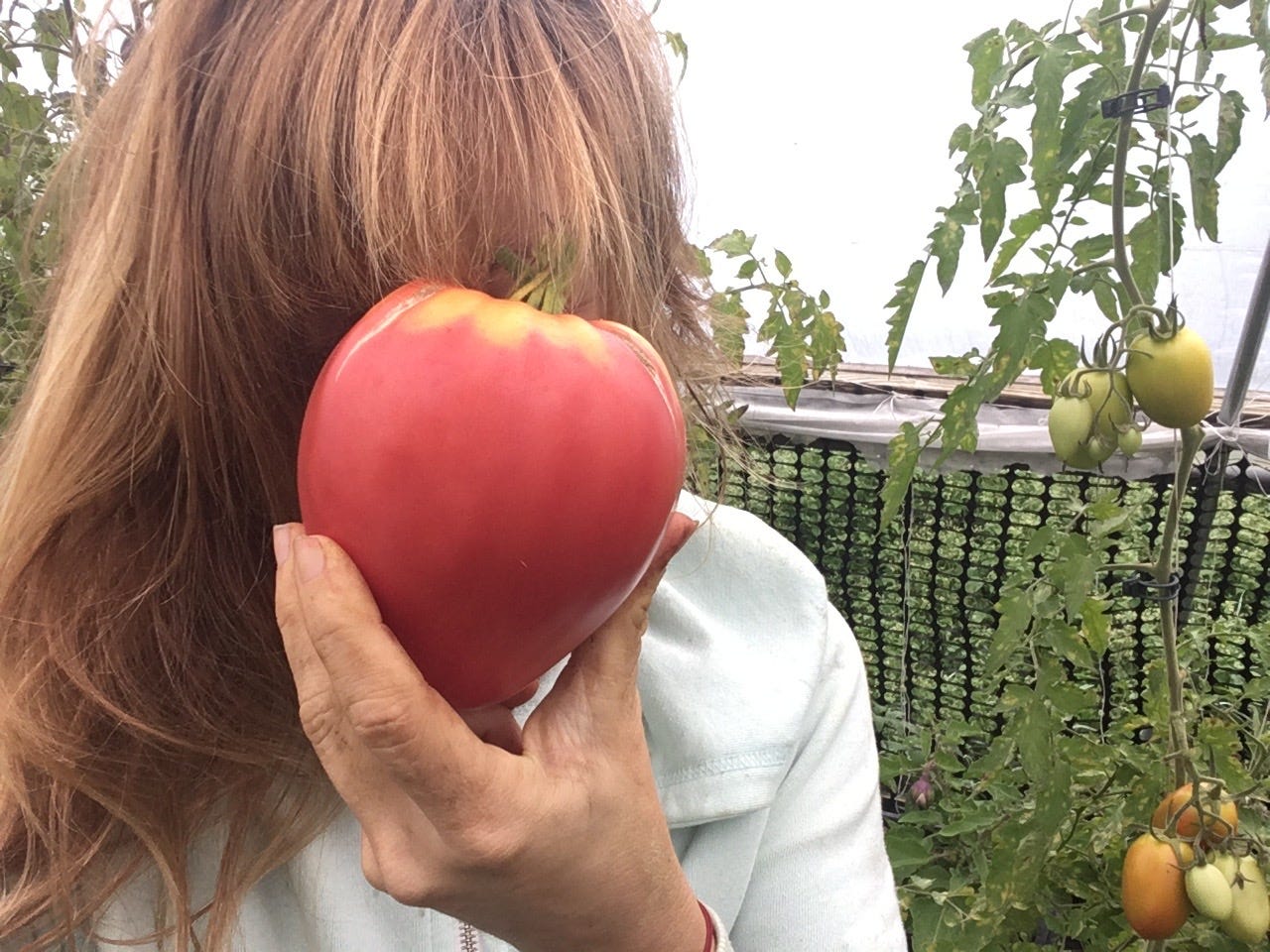
To me, tending tomatoes is not just gardening; it is relationship. A counterpoint to the fields outside of Homestead where thousands of acres produced the illusion of plenty while depleting the soil, poisoning waterways, and breaking bodies. The tomato in my hand—the heirloom, the oddball variety with a name like poetry—is a reminder that food could still be alive, intimate, particular. It could still be an act of love.


Corn
Mandan Bride corn grew in a Vermont garden, in quartz-rich soils at forest’s edge—though this variety carried the memory of the Great Plains, developed by the Mandan people along the Missouri River centuries before European contact. The Mandan had selected for ears that could ripen in their short northern seasons, kernels that dried well for winter storage. When Lewis and Clark wintered with the Mandan in 1804, they documented vast stores of this corn, the foundation of a complex trading culture.
After harvest, we dried the ears and nixtamalized them—soaking the kernels in lime water as Mesoamerican peoples had done for millennia, a process that unlocks niacin and transforms hard grain into soft, workable masa. Ground it by hand for tortillas, feeling the weight of stone against stone, the ancient alchemy of turning seed into sustenance.
Corn was both grain and ancestor, descended from teosinte, a wild grass of central Mexico that bore little resemblance to modern ears. Eight thousand years of indigenous selection transformed tiny, scattered seeds into the plump kernels we know. Each generation of corn could not survive without human hands—the kernels too tightly bound to the cob to scatter themselves. Plant and people had become partners in survival.
This year I planted my second generation of teosinte seeds, gifted to me from Flowering Tree Permaculture in New Mexico, in the Santa Clara Pueblo. When visiting that community, nothing marked the beginning or end of an activity without corn—cornmeal blown into the air, dropped at feet, everything blessed by corn. To hold those teosinte seeds was to hold the original compact between grass and human, to plant the wild ancestor alongside its domesticated descendant.
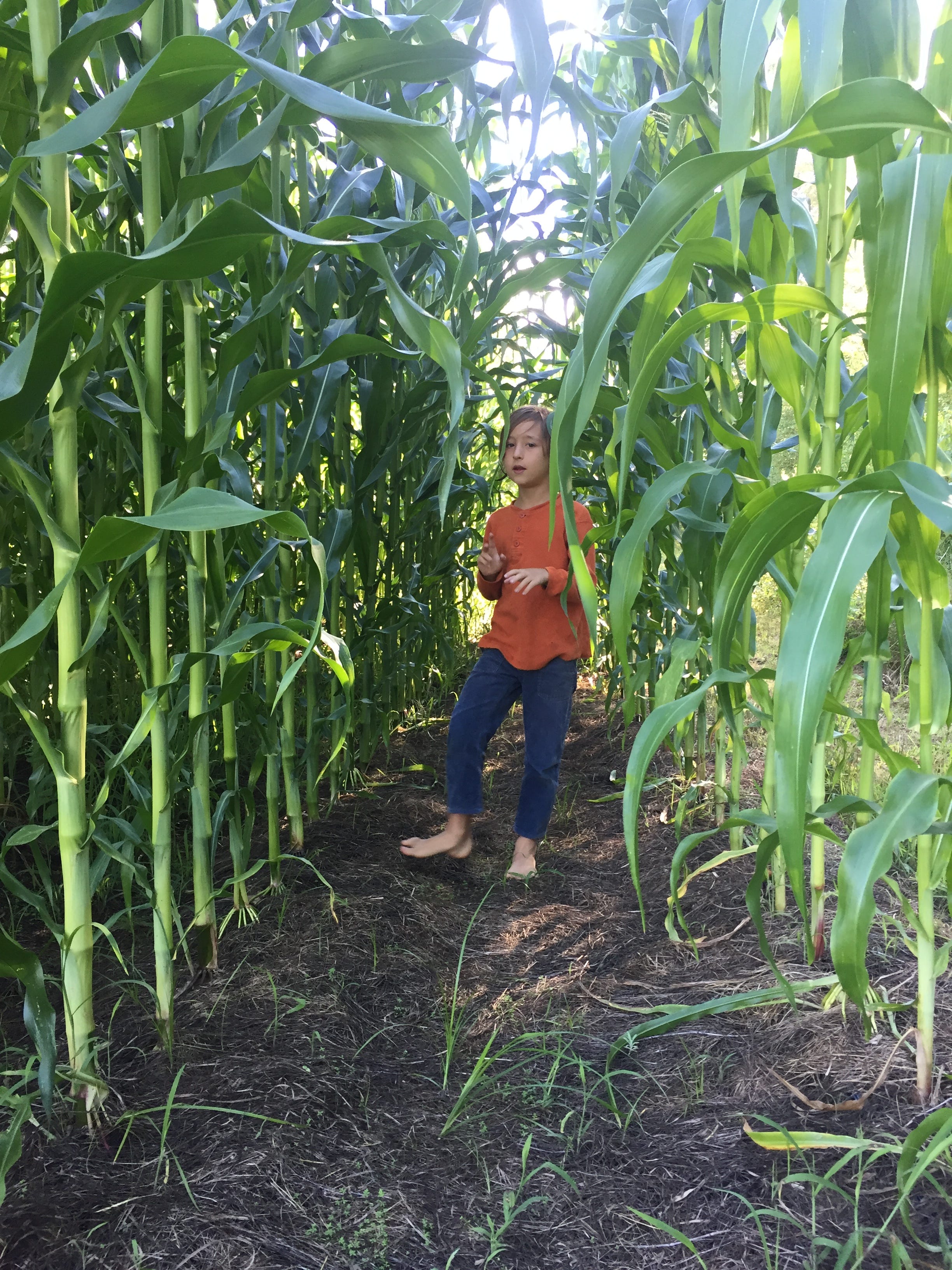
To walk a field of corn is to enter a cathedral. Stalks twelve feet high sway in collective song, their leaves creating corridors of green light. The air grows thick, humid with transpiration—each plant releasing hundreds of gallons of water into sky. Brace roots splay like toes gripping earth. Tassels release pollen onto silks, each thread a future kernel. You can hear the plants growing—a subtle crackling, like distant conversation. Stand still long enough and you might catch the rustle of an ear pushing from its sheath, the plant’s quiet urgency to reproduce.
But corn was efficient, hungry, relentless. It pulled nitrogen from soil faster than most crops, concentrated sugars and starches in ways that left earth depleted. Indigenous farmers knew this; they rotated corn with beans that fixed nitrogen, let fields rest, burned prairie grasses to return nutrients. Industrial agriculture abandoned such subtlety. It answered corn’s hunger with synthetic nitrogen, mined from fossil fuels, sprayed in quantities that overwhelmed soil systems. Waters answered back with algae blooms and dead zones.
In its sacred history, corn remained alive. Among the Pueblo, Hopi, Navajo (Dine), and countless others, corn was mother, sustenance, ritual. Creation stories told of humans formed from corn dough, their flesh made of the same stuff as their food. The “Three Sisters” planting—corn, beans, squash—remained one of the most elegant ecological teachings: corn providing structure for beans to climb, beans fixing nitrogen for corn and squash, squash leaves shading soil and deterring pests. Interdependence as survival strategy, written in seed.
The Hopi grew corn in colors that matched the six directions: yellow for north, blue for west, red for south, white for east, speckled for the zenith, sweet corn for the nadir. Each variety held its place in ceremony, its role in the turning of seasons. Corn pollen blessed newborns; corn ears were buried with the dead. To waste corn was to waste life itself.
Yet industrial corn stretched across continents, genetically modified to withstand herbicides, stacked with genes that turned leaves into pesticide factories. Planted year after year on the same exhausted ground, monocropped seas extended to every horizon. Each acre required vast quantities of water and fertilizer, destabilizing rivers and aquifers. The Ogallala Aquifer, once an underground sea beneath the Great Plains, dropped measurably each year to feed corn’s thirst. Each harvest extracted fertility without replenishment. Soil turned to dust, stripped of its fungal and bacterial lifelines. What had once been a sacred grass became a mechanism of depletion, a machine crop engineered for ethanol, animal feed, high fructose corn syrup.
The irony was sharp: a plant that had co-evolved with humans for eight millennia, that had fed civilizations from the Andes to the Arctic, reduced to raw material for industrial processing. Most Americans consumed pounds of corn daily without knowing it—in sodas sweetened with corn syrup, meat from corn-fed animals, processed foods thickened with corn starch. The corn had become invisible, abstracted from its origins in soil and sun.
And still, in the hands of seed keepers and small farmers, corn carried memory. Blue, red, black, and gold kernels glinted with stories, with resistance. Hopi blue corn, Seneca white, Bloody Butcher red, Glass Gem—each variety a library of adaptation, a record of human partnership with plant. Grinding my Mandan Bride corn into flour, I felt lineage in my palms, a continuity of gesture linking me to thousands of years of hands before mine, to Mandan grandmothers selecting the best ears for seed, to indigenous mothers teaching daughters the sacred work of transformation—grain into meal, meal into bread, bread into body, body into earth, earth into new growth.


Closing
No one truly knows the long-term effects of GMOs—on the land, on our bodies, or on the plants themselves. But I cannot stop thinking: a seed stripped of its ability to adapt, to select its next offspring, is a seed stripped of its intelligence. It is captivity disguised as abundance. Wild apples are resilient; cultivated apples are fragile. Wild species hold their own genius for survival; engineered ones do not.
To stand with green beans, tomatoes, and corn is to stand at the fault line between intimacy and industry. Between the slow, attentive work of tending and the blunt force of monoculture. Between food as relationship and food as commodity.
Each year, when I save seeds from my own garden, I feel the weight of continuity in my hands. The seeds are small, but they carry stories older than nations, older than empire. They ask me to pay attention, to notice difference, to value resilience over uniformity. In contrast, the industrial fields outside Homestead erased difference, erased memory, erased the hands that bent low to plant.
My art practice became a way of tracing these lines—of asking: What happens when we look closer, when we walk into the fields, when we taste the difference between a tomato from the store and a tomato from the garden? What is at stake when the people who harvest are hidden, silenced, sent back?
Green beans, tomatoes, corn—they are not only food. They are mirrors of culture, of labor, of exploitation and survival. They are also reminders of kinship, endurance, regeneration. They ask us to decide: Will we continue to consume them as products of extraction, or will we return to knowing them as relatives, as teachers, as seeds of possibility?