
Bitter Medicine Is Still Medicine — We Are Composting the Archive Into Content
Part 1

My daughter is playing a song I know by heart from before she was born. Not a cover. Not a sample. The original, arriving to her through an algorithm that doesn’t know or care that I first heard it at thirteen, riding the school bus home in the afternoon shadows of a Florida November. She sings along. She doesn’t know yet that she is singing my past. She thinks she is discovering something.
I don’t correct her. But something in me shifts.
There is an image in Mahayana Buddhism called Indra’s Net: an infinite web stretched across the cosmos, with a jewel at every node. Each jewel reflects all the others. And within each reflection, all the reflections again, endlessly, without a center, without a first image. I think of it differently when I imagine it made of water, made of dew, each drop trembling on a thread, holding the whole web inside its curved surface. A morning thing. Temporary. Conditional. The kind of thing that only appears at a particular angle of light.
What I want to say about culture is something like this: we are living inside the web. And the web has stopped trembling forward. It trembles in place.
This is not just a question of culture. It is a question of time, and what time feels like from inside it.
This is not the same as saying there are no new stories.
There are people right now writing genuinely strange and necessary things, farming new myths from overlooked corners of the world, from bodies that have never been centered in any canon, from languages that don’t translate cleanly, from relationships with land and species that Western narrative has not yet caught up to. New myths exist.
What’s different is the conditions under which stories travel, repeat, and become culture. And what’s happened to those conditions is not subtle. We didn’t just lose narrative diversity. We lost the understanding that stories were doing something to us.
We have built a machine that behaves less like a culture and more like a monoculture — efficient, extractive, and eerily unified in what it produces.
I know what the alternative looks like because I have practiced it.
In Waldorf education, we tell stories — we don’t read them. You take a tale in, live with it for days, let it move through you until it belongs to you in the way that only lived things do. And then you tell it to the children in front of you. Not from a book. Not from a script.
What happens in that space is the thing I’m trying to name.
The story comes out shaped by you, by what you noticed that morning, by which child in the third row has been carrying something heavy all week, by the quality of light in the room. Sometimes a detail shifts. Sometimes the emotional weight lands differently than it did the last time you told it. You are not distorting the story. You are doing what every teller before you has done: passing it through a living body, which changes it slightly, which keeps it alive.
The curriculum is built on this principle. Fairy tales for first grade: pure image, moral weight carried in symbol rather than statement. Fables in second, where the animal world begins to reflect the social one. Creation myths in third, when children start to ask where things come from and need a story large enough to hold the question. By fourth grade, when the child first feels something like fate pressing on them, the curriculum answers with Norse myth — gods who are also doomed, heroism that doesn't prevent loss. The stories move outward as the child does, from the interior fairy-tale forest to the edge of the cosmos, tracking the developmental moment with almost uncanny precision. The story meets the child where they are. It is calibrated not to what performs, but to what is needed.
There is no metric for this. No engagement score. No optimization loop. Only the felt sense that something has landed where it needed to.
The teller’s body is the medium. Not a screen. Not a platform. A person who has lived with the story long enough to let it reshape slightly in the telling. That is a technology of transmission that is nearly gone from mainstream culture, and with it, the mechanism by which stories stay alive.
When stories moved through communities, through grandmothers, through seasons, through the particular dialect of a particular valley, they mutated. Not arbitrarily. They mutated in response to what the teller knew, feared, needed, and couldn’t yet name.
Grandmother Spider weaves the world from herself, every telling an act of creation responsive to where and who and why. Anansi steals stories from the sky god and gives them to people, and in the stealing they change hands, change shape, change meaning. These stories survived because they were unowned, passed between tellers who altered them in the act of passing. They mutated because people needed them to.
Anansi’s stories survived the Middle Passage. They crossed from Ghana to Jamaica to Georgia to Harlem, picking up new danger and new vernacular at every node. The trickster who outwits the powerful became whatever the powerful looked like in each new place. The story stayed alive because it was doing real cultural work under conditions of erasure and survival. It changed because it had to.
This is what living myth looks like.
Carl Jung understood that we return to the same structures, that the hero, the trickster, the great mother, the shadow are not inventions of culture but shapes of consciousness itself. We can’t help returning to them. The question was never whether we’d return. The question is what we do when we get there.
What Jung could not have anticipated is a system that prevents those structures from changing once we arrive.
Spider-Man is not myth. Spider-Man is a franchise cycling through skins, same structure, same emotional beats, same resolution, owned, optimized, and served back to a global audience trained to find it satisfying. He is not myth because he cannot change in ways that matter. He is contractually obligated to remain himself.
The hero no longer grows. He reboots.
The stories we told in those classrooms were not always comfortable. Grimm’s fairy tales, even in their collected form, contain violence, gore, cruelty, abandonment, dismemberment. The jealous queen orders Snow White’s lungs and liver brought to her as proof of death. The stepsisters’ eyes are pecked out by doves at the wedding. The girl dances in red-hot iron shoes until she dies.
We kept those things in.
Not because we were indifferent to the children in front of us, but because we understood, in the way that generations of tellers before us understood, that the difficulty is not incidental. It is the mechanism. It is how the story works.
There is an entire tradition of fairytale interpretation that treats these texts the way art historians treat the symbolic programs of old master paintings, not as decoration, not as entertainment, but as encoded transmission. The carnation, the spindle, the red shoes, the glass mountain — objects, colors, numbers, animals, all of them doing something. Operative symbols, speaking below the threshold of conscious comprehension to something older and more foundational in the human soul. Cautionary tales for the world outside, yes — but also maps of the inner world. Psychic terrain drawn in the language of image.
When you sanitize those elements, when you remove the wolf’s teeth, soften the abandonment, resolve the darkness before it has a chance to sit, the story loses its action. It becomes inert. It tastes fine and does nothing.
Bitter medicine is still medicine. Optimized for palatability, it is no longer medicine at all.
Platform culture applies friction-removal to narrative the way industrial food production applies it to nutrition: efficiently, at speed, in response to measurable preference signals. The result is content that is easy to consume and quietly depleting. Stories stripped of their difficult elements, their symbolic density, their operative strangeness. Stories that resolve cleanly, that do not linger, that do not work on you in the night.
The archive of human story took tens of thousands of years to accumulate its medicine.
We are composting it into content in a single generation.
Meanwhile, your daughter is listening to your music.
Her friend is wearing the fashion you wore at fifteen. The film you grew up watching is being remade, and the remake is being remade, and the actor playing the lead was born the year the original was released.
There’s a reason this happens roughly every twenty to thirty years: memory fades but cultural objects remain, and platforms surface what performs, and what performs is what already lives in people’s nervous systems as familiar. TikTok compresses this cycle to weeks. You can watch an aesthetic emerge, peak, and become ironic within a single season. The loop speed increases. The loop itself never breaks.
Childhood is no longer distinct. It is recursive.
Your daughter is not discovering culture. She is inheriting a loop you already lived. The algorithm presents it without history--clean, decontextualized, as if it belongs to no one and has always been there.
Inside the web, in a sense, it has.
Here is the ecological truth I think about: monocultures are efficient. They scale. They are easy to manage and to monetize. And they are catastrophically fragile.
A monoculture doesn’t just reduce diversity, it erases the memory that diversity ever existed. The soil forgets what else it once grew. The conditions that supported other species become the conditions that suppress them. There is no seed bank. There is no cultural memory of the alternatives. Just the crop, wall to wall, as far as anyone living can see.
This is where your daughter becomes an indicator species.
She is not to blame for what she inherits. But what she inherits reflects the health of the ecosystem she was born into. When the narrative range available to a generation narrows to superheroes, celebrity arcs, competition loops, and nostalgia cycles — when the only stories that receive oxygen are the ones that have already proven they scale — something is being lost that leaves no trace of its absence.
We are living in a narrative monocrop. High yield. Low resilience. And quietly, the memory of other possibilities is being composted into the feed.
When the same narratives cycle, we don’t just watch them. We rehearse them. We build cities, institutions, relationships, and selves in their image. The story becomes the architecture.
The endless hero narrative produces individualism and its exhaustion, the self as project, the self as brand, the sole responsible party for its own survival. The competition loop produces identity tied to performance and the chronic instability that follows when performance wavers. The nostalgia cycle produces a culture that cannot imagine forward because it keeps finding the past more legible than the future.
This is behavioral. This is structural.
And it is also something stranger than that.
The Indra’s Net image is true in a way I don’t want to fully explain away. We are not separate nodes broadcasting at each other. We are already inside each other’s reflections; what lives in the shared imagination moves through a culture the way a tremor moves through a web, and what trembles there does not stay imaginary. It becomes visible through what we make, fund, build, repeat, normalize.
We do not manifest reality from nothing. But we enact what we collectively imagine. And when the same images dominate, when the same few archetypes receive all the oxygen, we don’t just watch the same stories. We limit what we know how to want. We constrain what reality feels like it can become.
The web shapes what is visible. And then we act accordingly.
So where are new myths supposed to come from?
Historically, they came from contact. From land, from survival, from the night sky and what couldn’t be explained, from the edge of what the community understood and the place where understanding ran out and something else had to fill it. They came from mystery, not the aesthetic of mystery, not the branding of mystery, but the actual encounter with the unknown.
Anansi emerged from the interface between human cunning and cosmic power. Grandmother Spider emerged from the relationship between human consciousness and the living world, the need to understand how things came to be woven together. These weren’t stories told for entertainment. They were technologies of orientation. They helped people know where they were.
Platform culture does not produce mystery. It resolves it, instantly, algorithmically. Every question gets an answer. Every symbol gets captioned. Every strange image is explained before it has a chance to mean something on its own.
Mystery requires time. It requires sitting in not-knowing. It requires the thing to remain at the edge of language long enough to generate something the language doesn’t already have.
We are not out of stories. We are out of conditions that generate stories.
My daughter sings along. The song fills the room, and for a moment I am thirteen again, and I am also here, watching her, a reflection inside a reflection inside the curve of a dew drop on a web I cannot see the edges of.
The web does not move forward. It trembles.
And in that trembling, everything appears and disappears and appears again—slightly differently, recognizably the same.
What I want to ask is not where did all the new stories go.
What I want to ask is: what would it take to change the conditions that keep the web trembling in place?
I don’t know. But I think the answer lives somewhere outside the feed.
Maybe outside, full stop.
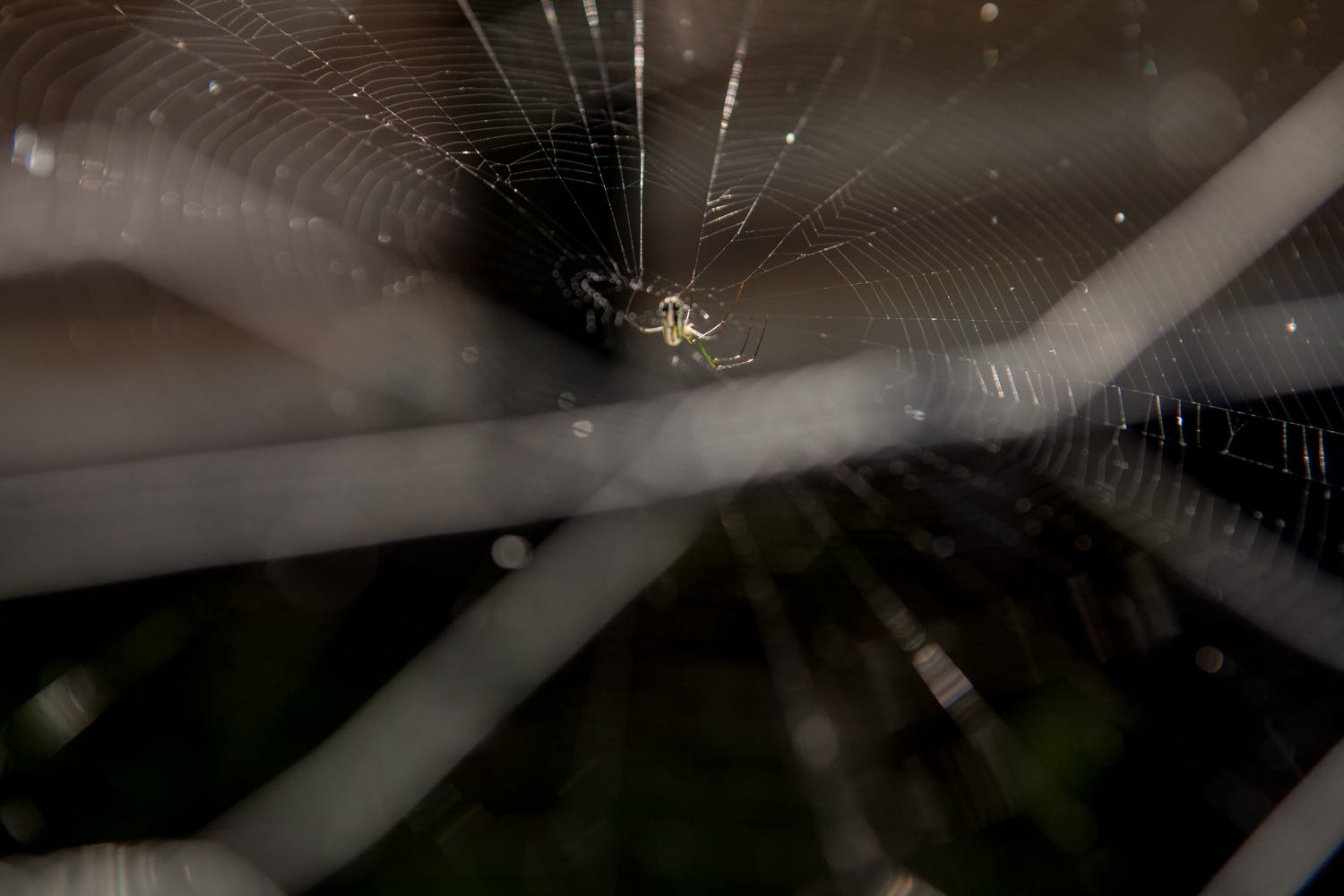
I like the Indra's Web image. It resonates with my own idea. I imagine we've been pushed to live inside of a web, inside of a web. The inside web is defined by the likes of Spider-Man's story, the wounded hero, the media messages, the man-made reality that tells the news stories. Unquestioned narratives that keep us living in the extraction societies, keep us impoverished mentally and financially.
It's a torus, and we go round and round and round in this trap. It is self-perpetuated by our expectations, fabricated by the elite that tells the story, the rewritten history that substantiates claims by repetition. Reinforced by "the authoritles" and subsequent, unquestioning generations. Resurrected, regurgitated, re-presented again repeatedly, one generation after the other in ever smaller circles. Self-enforced by the proofs and mythologies provided by sciences and religions that trap us, hold us in the material world we have come to rely upon to hold fear at bay.
But there's another realm outside of this a sphere, a sphere around the sphere, bounded by Nature, by the stars and by the sea, by our imaginations. By the reflections of dew drops on Celandine... It's not so much a boundary as it is the edge of our meristem, the growing edge of our evolution. We have been pushed inside of this into the inner sphere, the torus. we have been divested from our natural forefront, confined in the man-made. We have been weaned from our imaginations by modern convenience.
Pushing out again to our True Forefront requires inner effort, imagination and observation, to confront and reclaim. In the way a teacher has to "own" a story, we have to own our biographies. The act of becoming avantguard makes the ubiquitous obsolete. It renders the messages of hero/victim/savior narratives impotent. It collapses what the medias' feed into insignificance. We can shed these imposed expectations. We can regain wonder.